- Since March 6, 2026, federal prosecutors have acted in more than 400 cases against more than 800 defendants, and helped raid scam call centers and compounds in over 10 countries.
- The FBI reports it has restrained nearly $17 billion in illicit funds and helped dismantle more than 29 scam compounds across Asia, Africa, and the Middle East.
- Many of the schemes ran on phones: Georgia prison inmates made jury-duty threat calls from contraband phones, and a Peruvian call center threatened Spanish-speaking Americans with arrest or deportation.
- The FCC reports blocking more than 1,400 providers, including voice providers that carried scam calls impersonating government agencies, internet service providers, banks, and major retailers.
What the Justice Department announced
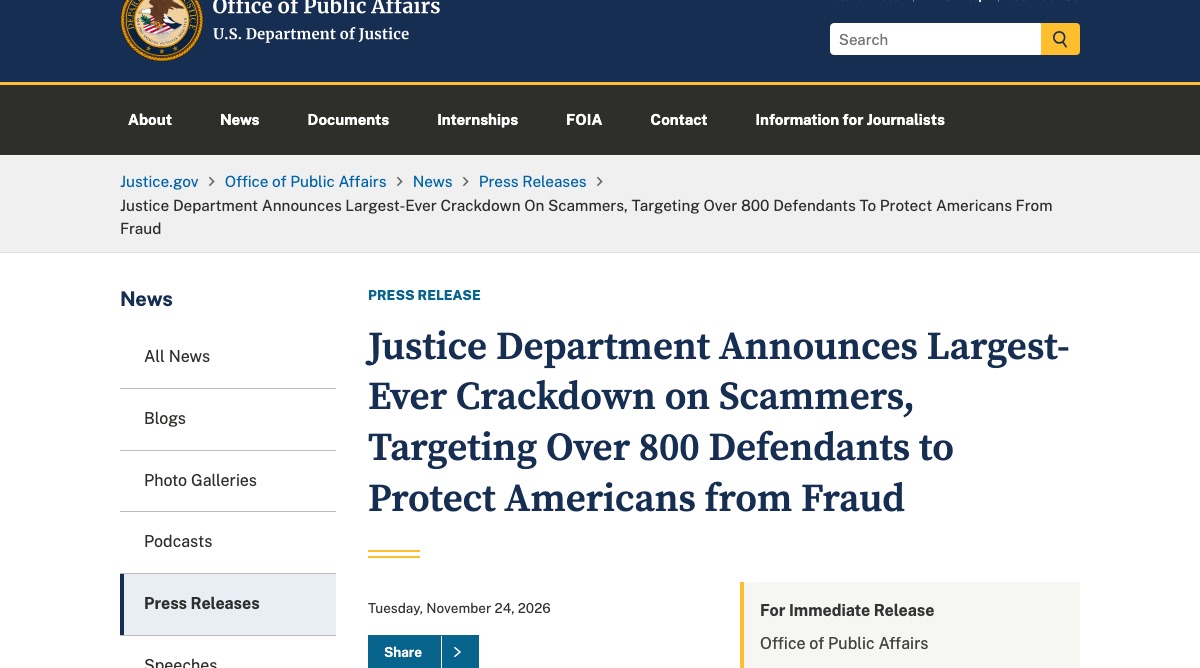
On November 24, 2026, the Justice Department reported the results of a government-wide surge against scam networks that began when Executive Order 14390 was signed on March 6, 2026. Since then, federal prosecutors have taken action in more than 400 cases against more than 800 defendants, a count that includes new charges, extraditions, guilty verdicts, and sentences. The results span 85 federal districts, 30 defendants were extradited to the United States, and U.S. prosecutors and agents helped law enforcement in over 10 countries raid foreign scam call centers and compounds that targeted Americans.
- FBI. Through Operation Blackout, the FBI has restrained nearly $17 billion in illicit funds, seized more than 14,000 digital devices, and helped identify, disrupt, and dismantle more than 29 scam compounds across Asia, Africa, and the Middle East. FBI support led foreign partners to arrest or detain more than 320 people overseas, and the FBI helped free and repatriate more than 2,200 trafficked workers forced to work in the compounds.
- State Department. U.S. and Southeast Asian law enforcement, funded and supported by the State Department, froze more than $1 billion in stolen cryptocurrency and took down more than 1.4 million fraudulent websites and accounts. In Moldova, raids in October closed five call centers.
- Secret Service and Homeland Security Investigations. The Secret Service restrained more than $200 million and disrupted 1,780 scam domains. HSI made more than 300 arrests.
- FTC. The FTC filed 16 actions during the surge, covering tech-support scams and government and business impersonation among other schemes.
The scale of the problem is large. The Justice Department cites Gallup’s estimate that Americans lost about $68 billion to scams in 2025. As the release itself notes, an indictment is an allegation, and defendants are presumed innocent until proven guilty.
Many of these scams start with a phone call
The cases the Justice Department highlights show how often the phone is the first point of contact:
- Jury-duty threats from prison. Current and former members of prison gangs in Georgia used contraband mobile phones to tell victims they had missed jury duty and would be arrested unless they paid a “fine.” Fourteen people were charged in three indictments, and another 17 for smuggling contraband phones into Georgia prisons.
- Call centers abroad. The operator of a Peruvian call center is charged with calling Spanish-speaking Americans and telling them they had to pay for English-learning products or face arrest or deportation.
- Lists that feed the calls. A list broker in Mexico is charged with knowingly selling the names and contact details of elderly Americans to dozens of scammers. A dozen defendants, including several Jamaican nationals, are charged in a sweepstakes scheme against elderly Americans.
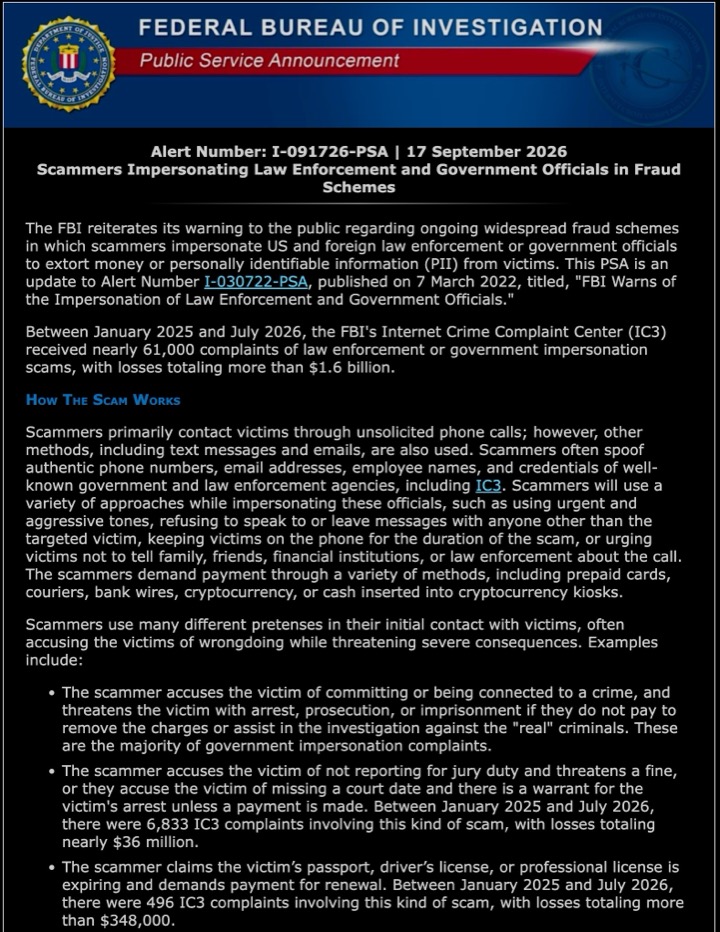
These are the same patterns behind the government-impersonation calls that cost victims $1.6 billion in 19 months: a trusted name, an urgent threat, and a phone call that looks legitimate.
What the FCC is doing
The Justice Department’s release also lists the FCC’s part in the effort:
- Prison jamming. On November 19, 2026, the FCC approved a rule allowing federal and state prisons and jails to use jamming technology to block calls from contraband cell phones, the tool behind the Georgia jury-duty scams.
- Providers cut off. The FCC says its enforcement and reforms led to the blocking of more than 1,400 providers and 296 million illegal robocalls. That includes removing from U.S. networks voice providers that carried scam calls impersonating government agencies, internet service providers, banks, and major retailers.
For voice providers, the second point matters most. The FCC has shown it will cut off providers whose networks carry these calls, as it did when it removed 14 providers from the Robocall Mitigation Database in September.
Why it matters to leadership
The surge shows enforcement moving closer to the call itself: to the call centers, the phones, the contact lists, and the networks that carry the traffic. For a voice provider, the question is no longer only whether a robocall campaign crossed its network, but whether it can show who sent the traffic and answer a traceback request quickly. For a bank, retailer, or agency, it is whether it would know that its name or number was being used to call its customers, and whether it has the evidence carriers and investigators need.
Questions to answer now
| # | Action | Owner | Timing |
|---|---|---|---|
| 1 | Confirm you can identify every customer and upstream provider that sends you traffic (Know Your Customer and Know Your Upstream Provider). | Voice provider compliance lead | Now |
| 2 | Check that traceback requests are answered within the required time, with a named owner and a backup. | Network operations | Now |
| 3 | Review traffic for calls that impersonate government agencies, banks, internet service providers, or retailers. | Fraud and network teams | This quarter |
| 4 | For brands and agencies: find out whether your names and numbers appear in calls you did not make, and keep the evidence. | Security and fraud leaders | This quarter |
The VoiceAlerts Compliance Team can review these questions with you in a free 30-minute briefing.
Key dates
| Date | Milestone |
|---|---|
| Mar 6, 2026 | Executive Order 14390 directs a government-wide crackdown on scams. |
| Oct 2026 | Raids in Moldova close five call centers; a Chinese national is extradited from the Netherlands in a Cambodia-based crypto scam case. |
| Nov 19, 2026 | The FCC approves jamming of contraband phones in prisons and jails. |
| Nov 24, 2026 | The Justice Department announces its largest-ever crackdown on scammers. |
How VoiceAlerts helps
VoiceAlerts verifies who originates your traffic and who hands it to you (KYC and KYUP), keeps STIR/SHAKEN tokens healthy, and maintains the evidence behind your Robocall Mitigation Database filing, so scam traffic is caught before it becomes an enforcement problem.
- Know Your Customer and Know Your Upstream Provider checks
- Traceback readiness and response times
- Calls that impersonate government agencies, banks, and retailers
Common questions
What did the Justice Department announce on November 24, 2026?
It reported the results of an anti-scam surge that followed Executive Order 14390 of March 6, 2026: action in more than 400 cases against more than 800 defendants, including new charges, extraditions, guilty verdicts, and sentences, results in 85 federal districts, 30 extraditions, and help with raids on scam call centers and compounds in over 10 countries.
How much money did the FBI recover from scam networks?
The Justice Department’s release says the FBI’s Operation Blackout has restrained nearly $17 billion in illicit funds, seized more than 14,000 digital devices, and helped dismantle more than 29 scam compounds. Separately, the FBI’s Recovery Asset Team froze more than $350 million in assets under Operation Level Up.
What has the FCC done against scam calls?
According to the Justice Department’s release, the FCC approved a rule on November 19, 2026 allowing federal and state prisons and jails to jam calls from contraband phones, and its enforcement and reforms led to the blocking of more than 1,400 providers and 296 million illegal robocalls, including voice providers that carried calls impersonating government agencies, internet service providers, banks, and major retailers.
How much do Americans lose to scams?
The Justice Department cites Gallup’s estimate that Americans lost about $68 billion to scams in 2025, and that 10% of U.S. adults experienced a scam directly or through someone in their household in the past year.
Sources
- justice.govU.S. Department of Justice: Justice Department Announces Largest-Ever Crackdown on Scammers, Targeting Over 800 Defendants to Protect Americans from Fraud (Press Release 26-1404)November 24, 2026
- helpnetsecurity.comHelp Net Security: US seizes nearly $17 billion in global war on scam ringsNovember 27, 2026 (coverage of the release)
This article is for general information and is not legal advice. Proposed rules can change before adoption; check the FCC record for the final text.