- A deficient Robocall Mitigation Database filing is enough to be cut off from every U.S. network. The 14 providers removed on September 2 ignored repeated requests to fix their filings.
- Failing to answer traceback requests within 24 hours is now an active ground for removal. Nine more providers were ordered to cure that failure or face removal.
- Inaccurate filings carry a $10,000 base fine, and stale filings $1,000. Both accrue as continuing violations until the record is corrected.
- A pending FCC proposal would raise the bar further: "affirmative, effective" mitigation, screening of new filers, and faster removal. On November 10, 2026, 49 state attorneys general urged the FCC to adopt it and to go further.
What happened
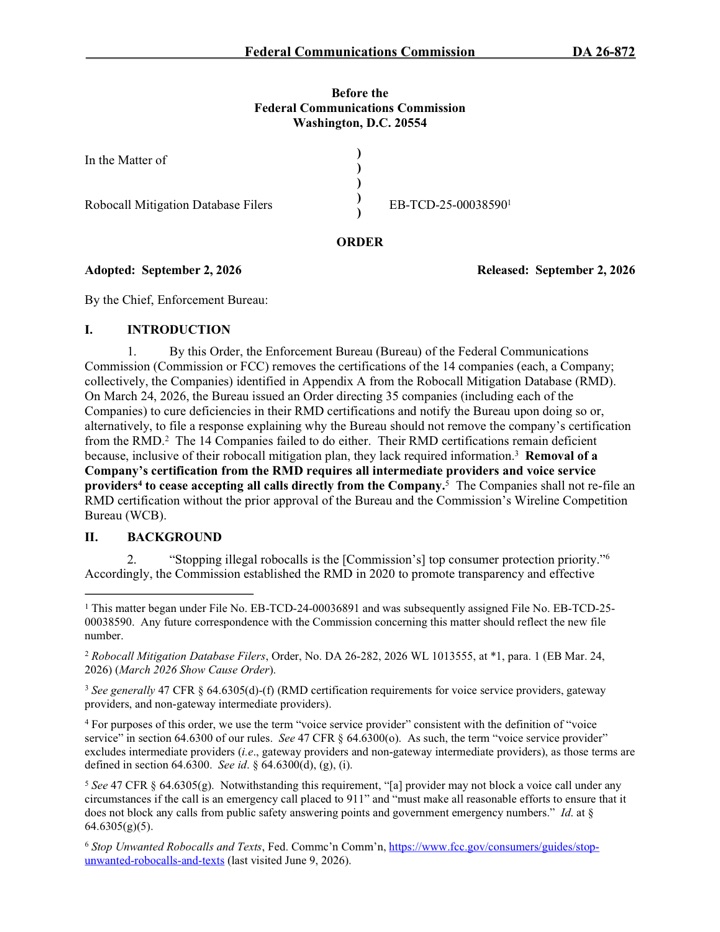
On September 2, 2026, the FCC’s Enforcement Bureau removed 14 companies from the Robocall Mitigation Database (RMD) and directed every voice service provider and intermediate provider to stop accepting their calls. Under FCC rules, U.S. providers may accept traffic directly only from providers whose filings appear in the database and have not been removed. Removal therefore disconnects a provider from the U.S. network.
The removals followed a long, documented process. The 14 companies were among 2,411 providers ordered in December 2024 to fix deficient filings, and among 1,203 removed in August 2025. They were provisionally reinstated after asking to return, notified of specific deficiencies between September 2025 and January 2026, and ordered on March 24, 2026, to cure them within 14 days. None responded. None may file again without the approval of both the Enforcement Bureau and the Wireline Competition Bureau.
A week earlier, on August 27, the Bureau opened a second front: it ordered nine companies that had failed to respond to multiple traceback requests from the Industry Traceback Group to cure the failure or explain why they should not be removed. Every RMD filer commits to answering traceback requests within 24 hours, and the Bureau now treats a broken commitment as a deficient filing.
Why it matters to leadership
- Removal is an existential risk, not a fine. Downstream partners must stop accepting your traffic within two days of a removal order.
- The trigger is paperwork. These providers were not removed for a robocall campaign. They were removed for incomplete filings and unanswered notices.
- Penalties now compound. Since February 5, 2026, the base forfeiture is $10,000 for false or inaccurate information and $1,000 for failing to update a filing within 10 business days of a change. The FCC treats both as continuing violations until the record is corrected.
- Your partners are watching. Every provider that accepts your traffic is obligated to check your status, and the FCC is proposing to specify how often they must check.
The largest cost is not the fine. A removed provider loses every U.S. route for its traffic, and with it the revenue on that traffic, within two days. It cannot file again without the approval of two FCC bureaus, and its customers must move to another provider.
Where filings fall short
An RMD filing covers five areas: certifications, the robocall mitigation plan, corporate identity, the provider’s role and enforcement history, and its traceback commitment. Each has specific content requirements, and a gap in any one of them can make the entire filing deficient. The FCC’s orders show that most removals start with information that was missing, outdated, or never supported by evidence.
Know Your Customer and Know Your Upstream Provider practices, both part of the mitigation plan, are also the subject of separate FCC proposals. Providers that can document both are in a stronger position on every front, including the numbering rules covered in our analysis of the FCC’s November 19 vote.
What the FCC is proposing next
In July 2026 the Commission proposed a broad overhaul of the database (FCC 26-49). The comment cycle closed with reply comments on November 9, 2026, and the next step is a Commission order. Nothing below is final.
- A higher standard for mitigation: “affirmative, effective measures” instead of “reasonable steps,” covering all illegal calls, not only robocalls.
- A certification of compliance with all FCC illegal-call and numbering rules, giving the Bureau a direct basis for removal when any of them is violated.
- More disclosure: third-party vendors used for analytics and mitigation, details on each principal (including country of residence and citizenship), and a registered U.S. agent.
- Screening of new filers and better tools to identify non-compliant providers already in the database.
- Codified causes for removal, faster removal processes, and a defined path, and limits, for reinstatement.
- Mandatory customer notice from a removed provider, and a set deadline for downstream providers to stop accepting its calls.
States and banks back a stricter database
The reply round showed broad support for tightening the database. On November 10, 2026, the National Association of Attorneys General filed reply comments on behalf of a bipartisan group of 49 attorneys general, led by North Carolina. The attorneys general supported the FCC’s proposals to suspend or remove bad actors, tighten the content of mitigation plans, and require evidence of solvency, and they asked the Commission to go further:
- Vet before listing. Check the information a provider submits before the provider appears in the database and can start sending traffic.
- Certify compliance. Require each filer to certify that it complies with the FCC’s robocall rules.
- Close the revolving door. Stop removed providers from returning under a new name or a new entity.
- Keep the record. Preserve the history of removed providers and make it available to law enforcement.
The filing is part of the states’ Operation Robocall Roundup, which began in 2025 with warning letters to 37 providers. On November 9, the Bank Policy Institute and other financial-services trade associations also filed comments supporting the FCC’s proposal. When state enforcers and the largest callers ask for the same changes, providers should plan for a database that is checked more often, by more parties, and with less patience for errors.
Questions to answer now
Every RMD filer should be able to answer the following with confidence:
| # | Question for your leadership team | When |
|---|---|---|
| 1 | Would our RMD filing pass an FCC deficiency review today? | Now |
| 2 | Would an FCC notice or a traceback request reach the right person, and be answered within 24 hours? | Now |
| 3 | Would we know if our filing became outdated, in time to correct it within 10 business days? | This quarter |
| 4 | Can we show that every provider we accept traffic from is in good standing? | This quarter |
| 5 | Could we produce the evidence behind our mitigation plan if the FCC asked for it? | Before new rules |
Answering these questions accurately takes a review of your filing and the evidence behind it. The VoiceAlerts Compliance Team can tell you where you stand, and what to prioritize, in a free 30-minute briefing.
Key dates
| Date | Milestone |
|---|---|
| Feb 5, 2026 | $10,000 and $1,000 base forfeitures for inaccurate and outdated filings take effect. |
| Mar 24, 2026 | Bureau orders 35 providers to cure deficient filings within 14 days. |
| Jul 23, 2026 | FCC releases its proposal to overhaul the database (FCC 26-49). |
| Aug 27, 2026 | Nine providers ordered to cure failures to respond to traceback requests. |
| Sep 2, 2026 | Fourteen providers removed; downstream providers must stop accepting their calls. |
| Nov 9, 2026 | Reply comments due on FCC 26-49; financial-services trade associations file in support. |
| Nov 10, 2026 | 49 state attorneys general urge the FCC to vet filers and keep removed providers out. |
| Next | A Commission order on FCC 26-49. No date has been announced. |
How VoiceAlerts helps
VoiceAlerts verifies who originates your traffic and who hands it to you (KYC and KYUP), keeps STIR/SHAKEN tokens healthy, and maintains the evidence behind your Robocall Mitigation Database filing, so the filing stays accurate as your network changes.
- Your filing checked against each required element
- Know Your Customer and Know Your Upstream Provider evidence
- Traceback readiness and STIR/SHAKEN status
Common questions
Why did the FCC remove 14 providers from the Robocall Mitigation Database?
On September 2, 2026, the Enforcement Bureau removed 14 providers whose filings remained deficient after a March 24, 2026 order to cure them within 14 days. None responded. Other providers had to stop accepting their traffic within two days.
What are the fines for inaccurate Robocall Mitigation Database filings?
Since February 5, 2026, the base forfeiture is $10,000 for false or inaccurate information and $1,000 for failing to update a filing within 10 business days of a change. The FCC treats both as continuing violations until corrected.
Can failing to answer traceback requests lead to removal?
Yes. Every filer commits to respond to traceback requests within 24 hours. On August 27, 2026, the Bureau ordered nine providers that failed to respond to multiple traceback requests to cure the failure or face removal.
What did the state attorneys general ask the FCC to change in the Robocall Mitigation Database?
In reply comments filed November 10, 2026, a bipartisan group of 49 attorneys general asked the FCC to vet information before a provider appears in the database, require providers to certify compliance with the FCC's robocall rules, keep removed providers from returning under new names, and make the history of removed providers available to law enforcement. They also supported the FCC's proposals to suspend or remove bad actors and to require evidence of solvency.
How can VoiceAlerts help keep an RMD filing safe?
VoiceAlerts verifies the customers and upstream providers behind a provider's traffic, keeps STIR/SHAKEN tokens healthy, and maintains the evidence behind the robocall mitigation plan, so the filing stays accurate as the network changes.
Sources
- docs.fcc.govFCC News Release: FCC Cuts Off Providers for Violating Robocall RulesSeptember 2, 2026
- docs.fcc.govFCC Enforcement Bureau Order removing 14 companies from the Robocall Mitigation Database (DA 26-872)September 2, 2026
- docs.fcc.govFCC Enforcement Bureau Order directing 35 companies to cure deficient RMD certifications (DA 26-282)March 24, 2026
- docs.fcc.govFCC Enforcement Bureau Order on nine companies that failed to respond to traceback requests (DA 26-873)August 27, 2026
- federalregister.govFederal Register: Improving the Effectiveness of the Robocall Mitigation Database; CORES Registration System (FCC 24-135)Effective February 5, 2026
- docs.fcc.govFCC 26-49: Improving the Effectiveness of the Robocall Mitigation Database, Further Notice of Proposed RulemakingReleased July 23, 2026
- federalregister.govFederal Register: Improving the Effectiveness of the Robocall Mitigation Database (FCC 26-49), comment datesReply comments due November 9, 2026
- naag.orgNational Association of Attorneys General: 49 Attorneys General Urge FCC to Strengthen Robocall Mitigation DatabaseReply comments, November 10, 2026
- ncdoj.govNorth Carolina Department of Justice: Attorney General Jeff Jackson Calls for Improvements to Federal Robocall DatabaseLead state, November 10, 2026
- bpi.comBank Policy Institute: Financial Services Trades Comment on FCC Robocall Mitigation Database ProposalNovember 9, 2026
This article is for general information and is not legal advice. Proposed rules can change before adoption; check the FCC record for the final text.