- From November 25, an opt-out from one type of informational call or text no longer has to stop all of them. An opt-out from telemarketing still stops all telemarketing from that caller.
- Callers can designate one or more of three automated opt-out methods as the only ones they must honor, provided the method is disclosed clearly on every call and text.
- Every call or text sent without valid consent, including after an opt-out, can cost $500 in statutory damages, or up to $1,500 if willful or knowing.
- The FCC is already asking whether to shorten the 10-business-day deadline to honor opt-outs and to require two-way texting. Comments are due November 25.
What changes on November 25
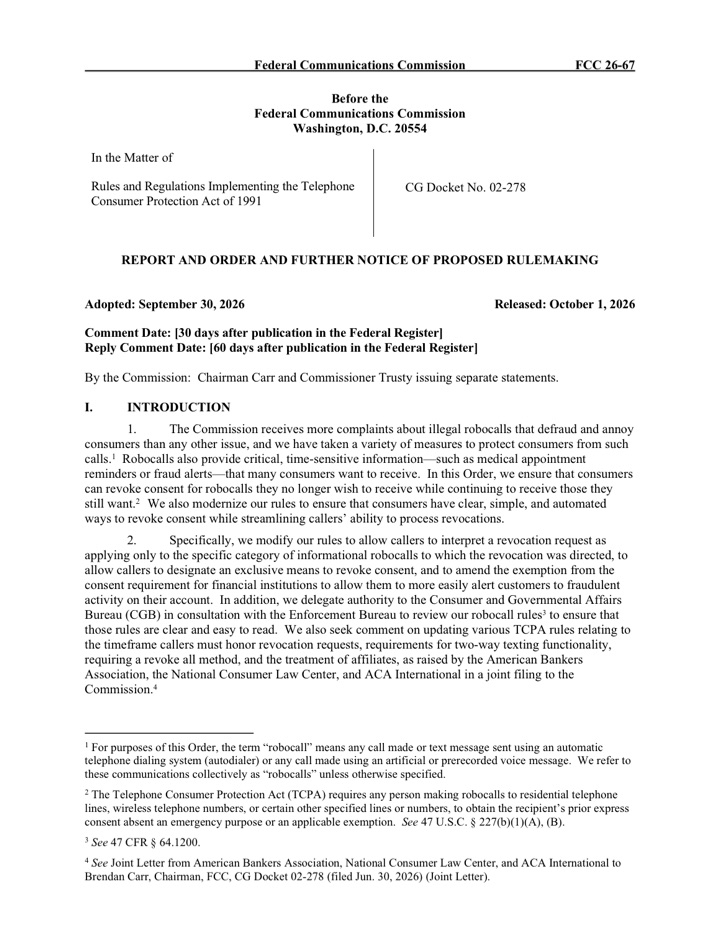
The FCC adopted the order on September 30, 2026 (FCC 26-67), and it takes effect on November 25, 2026. It applies to “robocalls” in the TCPA sense: calls and texts sent with an autodialer, and calls that use an artificial or prerecorded voice. The order makes three changes. The Commission states that it imposes no new compliance obligation; each change gives callers an option, and the benefit depends on how well they implement it.
1. Opt-outs can be limited to the type of message
Under the 2024 rules, an opt-out in response to one type of call would have stopped every robocall and robotext from that caller. That “revoke all” requirement had been postponed to January 31, 2027, and the new rule replaces it before it ever took effect.
- Informational messages: a caller may treat an opt-out as applying only to the category it answered. A customer who stops payment reminders can still receive fraud alerts, appointment reminders, or outage notices.
- Telemarketing: unchanged in effect. An opt-out from any telemarketing or advertising robocall stops all of them from that caller.
2. Callers can designate the opt-out method
Today, callers must honor an opt-out made by any reasonable means. From November 25, a caller may instead designate one or more of three methods as the exclusive ones:
- An automated voice or key-press opt-out offered during the call;
- A reply text using a standard opt-out word; or
- A website or telephone number the caller provides for opt-outs.
The condition is disclosure: the designated method must be stated clearly and conspicuously on each call or in each text. Texts can meet this by naming one standard word, such as “Reply STOP to opt out,” but senders must still honor all seven: stop, quit, end, revoke, opt out, cancel, and unsubscribe. A caller that does not designate a method must continue to honor any reasonable request. Opt-out mechanisms already required for exempt and telemarketing calls do not change.
3. Wider reach for bank fraud alerts
Financial institutions may send exempt fraud and security alerts to a mobile number obtained from a reliable source, not only a number the customer provided directly. Reliable sources are a spouse or family member authorized on the account, the number a customer calls from, and records received from another financial institution. The existing limits remain, including no more than three messages per event over three days. The FCC specifically encourages institutions to use the Reassigned Numbers Database so alerts do not reach a number’s previous holder.
What is at stake
The new options lower compliance costs only for callers that implement them correctly. The cost of a mistake is unchanged.
Statutory damages. The TCPA allows consumers to sue for $500 for each call or text made in violation of the rules, and a court may increase that to $1,500 per violation if the violation was willful or knowing. A robocall or robotext sent after consent was revoked is made without consent. For illustration, 1,000 messages sent after opt-outs that were not honored represent up to $500,000 in damages, or $1.5 million if willful.
What does not change
- The deadline to honor an opt-out remains a reasonable time, not to exceed 10 business days.
- Consent requirements for robocalls and robotexts are unchanged.
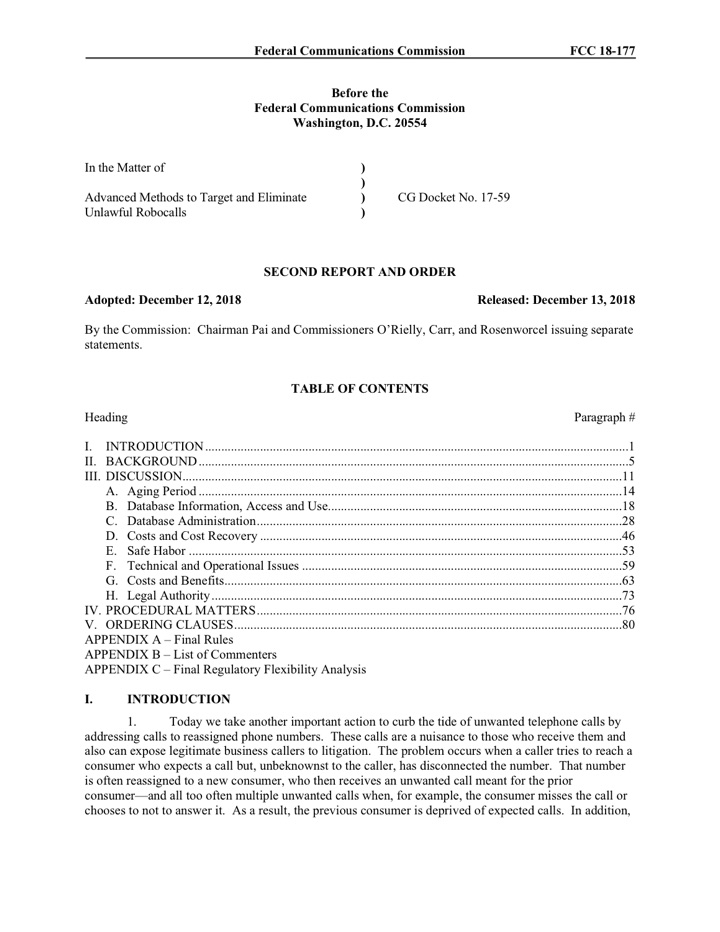
- The Reassigned Numbers Database safe harbor is unchanged. Checking whether a number has been reassigned remains the way to avoid calling someone who never consented, as covered in our guide to the database.
What the FCC may change next
A further notice, with comments due November 25 and replies due December 28, 2026, asks whether to:
- Shorten the 10-business-day deadline, for example to seven business days, as banking, consumer, and collections groups jointly suggested.
- Require two-way texting, removing the option to send texts that cannot receive a reply, either for all texts or only for marketing messages.
- Require a one-step “revoke all” option as the condition for limiting opt-outs to one category.
- Clarify how opt-outs apply across affiliates, lines of business, and divisions, and across numbers on the same account.
Organizations that build automated, category-level opt-out handling now will be positioned for any of these outcomes.
Questions to answer now
Before November 25, leadership should be able to answer the following with confidence:
| # | Question for your leadership team | When |
|---|---|---|
| 1 | Which of our calls and texts are informational, and which are telemarketing? | Before Nov 25 |
| 2 | Should we designate an exclusive opt-out method, and would our current scripts and templates meet the disclosure condition? | Before Nov 25 |
| 3 | Are opt-outs honored consistently across every system and vendor, within the deadline? | This quarter |
| 4 | Do we confirm that a number has not been reassigned before we call or text it? | Ongoing |
| 5 | Should we comment on the further notice? | By Nov 25 |
Answering these questions accurately takes a review of your calling and texting programs, systems, and vendors. The VoiceAlerts Compliance Team can tell you where you stand, and what to prioritize, in a free 30-minute briefing.
Key dates
| Date | Milestone |
|---|---|
| Sep 30, 2026 | FCC adopts the order and further notice (FCC 26-67). |
| Oct 26, 2026 | Published in the Federal Register. |
| Nov 25, 2026 | New rules take effect; comments due on the further notice. |
| Dec 28, 2026 | Reply comments due. |
How VoiceAlerts helps
VoiceAlerts runs Reassigned Numbers Database checks as a Somos-registered agent and maintains an audit-ready compliance trail, so the numbers you call still belong to the customers who consented.
- Your consent and opt-out practices under the new rules
- Reassigned Numbers Database checks and the TCPA safe harbor
- Audit-ready compliance evidence
Common questions
What changes in the TCPA opt-out rules on November 25, 2026?
Callers may treat an opt-out from an informational robocall or robotext as applying only to that category of message, may designate one or more of three automated methods as the exclusive way to opt out if disclosed on every call and text, and financial institutions may send fraud alerts to mobile numbers obtained from reliable sources.
How long do callers have to honor an opt-out?
A reasonable time not to exceed 10 business days. The FCC is asking whether to shorten that deadline, for example to seven business days; comments are due November 25 and replies December 28, 2026.
What are the damages for calls or texts made without consent?
The TCPA lets consumers sue for $500 per violation, and a court may increase that to $1,500 if the violation was willful or knowing.
How can VoiceAlerts help with the new opt-out rules?
VoiceAlerts runs Reassigned Numbers Database checks as a Somos-registered agent and maintains an audit-ready compliance trail, so the numbers an organization calls still belong to the customers who consented.
Sources
- docs.fcc.govFCC 26-67: Rules and Regulations Implementing the Telephone Consumer Protection Act of 1991, Report and Order and Further Notice of Proposed RulemakingAdopted September 30, released October 1, 2026
- docs.fcc.govFCC Public Notice DA 26-1159: Effective date for robocall rules and comment dates for the further noticeOctober 27, 2026
- federalregister.govFederal Register: Enhancing the Ability of Consumers To Control the Robocalls (final rule, 91 FR 67214)Effective November 25, 2026
- federalregister.govFederal Register: Modernizing the Ability of Consumers To Control Robocalls (proposed rule, 91 FR 67239)Comments due November 25, replies December 28, 2026
- law.cornell.edu47 U.S.C. 227(b)(3): Telephone Consumer Protection Act, private right of action
- ecfr.goveCFR: 47 CFR 64.1200, Delivery restrictions
This article is for general information and is not legal advice. Proposed rules can change before adoption; check the FCC record for the final text.