- Voxbeam faces a proposed $4.5 million fine for carrying tens of thousands of calls from a foreign provider that was never listed in the Robocall Mitigation Database.
- Telnyx faces a proposed $4,492,500 fine, or $2,500 per call, after two accounts opened under false identities placed 1,797 FCC-impostor calls.
- Both cases turn on the same duty: know your customers, know your upstream providers, and act on red flags such as long-dormant accounts that suddenly carry heavy traffic.
- Both are proposals, not final orders, and Telnyx disputes the allegations. The FCC's expectations are nonetheless on the record.
Two cases, one message
The FCC has now proposed multimillion-dollar fines against two voice providers for the same underlying failure: not knowing who was using their networks. One case concerns an upstream provider, the other a provider’s own customers. Together they show how the Commission expects providers to vet the traffic they accept and originate.
Voxbeam: carrying an unlisted upstream provider
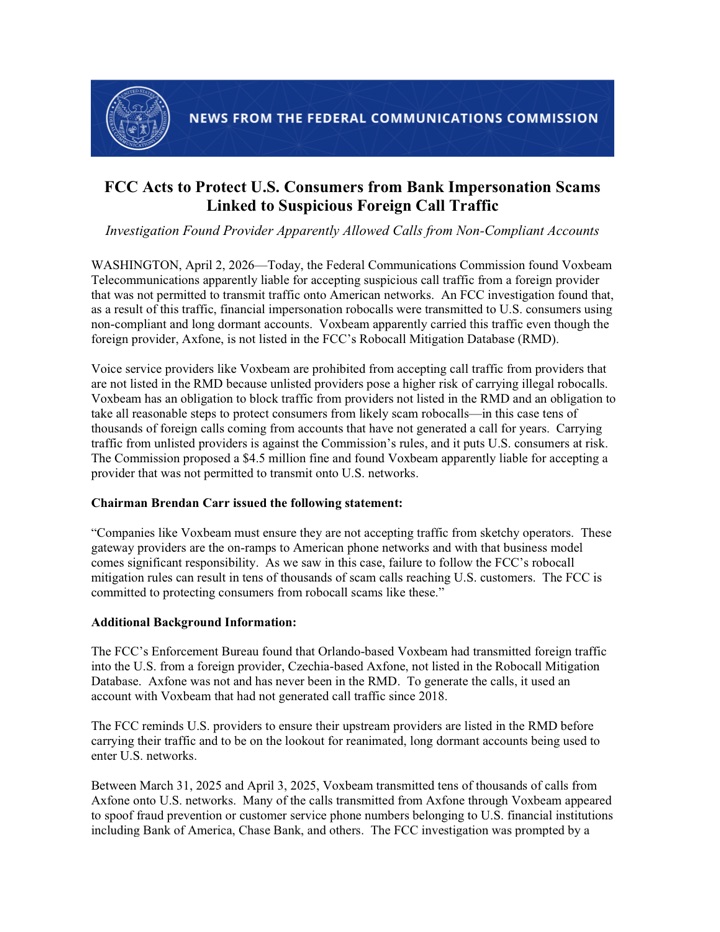
On April 2, 2026, the FCC found Orlando-based Voxbeam Telecommunications apparently liable and proposed a $4.5 million fine. Between March 31 and April 3, 2025, Voxbeam transmitted tens of thousands of calls onto U.S. networks, 60,873 calls bearing more than 2,812 U.S. caller IDs according to the FCC’s notice, from Axfone, a provider based in Czechia that was not, and never had been, listed in the Robocall Mitigation Database.
- The calls impersonated banks. Many appeared to come from the fraud-prevention or customer-service numbers of Bank of America, Chase, and other institutions. The investigation began with a complaint from a financial institution whose customers were receiving calls that appeared to come from its fraud reporting number.
- The account was a red flag. Axfone used a Voxbeam account that had not generated traffic since 2018.
- The rule is clear. Providers may not accept traffic from providers that are not listed in the database, and the FCC reminded providers to watch for “reanimated, long dormant accounts.”
Telnyx: customers who were not who they claimed
In February 2025, the FCC proposed a $4,492,500 penalty against Telnyx, finding that it apparently failed to take “affirmative, effective measures” to prevent new customers from originating illegal calls, as the FCC’s know-your-customer rule requires.
- Two accounts opened on February 6, 2024 with a name, an email address, an IP address, and the same Toronto hotel address. The FCC later found the identifying information was false and could not identify who opened either account.
- On February 6 and 7 they placed 1,797 calls with prerecorded messages from a fictitious FCC “Fraud Prevention Team,” reaching FCC staff and their families among others. Telnyx flagged one account for review and terminated it on February 7.
- Telnyx disputes the allegations and has asked the FCC to withdraw the proposed fine.
What not knowing costs. The proposed penalties total almost $9 million. Telnyx’s works out to $2,500 for each of the 1,797 calls, placed by accounts that existed for about two days.
Status. Both actions are Notices of Apparent Liability: allegations and proposed penalties, not final decisions. Each company may respond before the Commission acts further.
What the FCC expects
Read together, the cases describe the standard a provider is measured against: verify that every upstream provider is listed in the Robocall Mitigation Database, verify the identity of customers who can originate significant call volume, and act on red flags rather than wait for complaints. The same expectations drive the FCC’s pending proposals to tighten the database, covered in our analysis of the latest RMD removals, and its scrutiny of who obtains numbers, covered in our analysis of the November 19 vote.
Questions to answer now
Provider leaders should be able to answer the following with confidence:
| # | Question for your leadership team | When |
|---|---|---|
| 1 | Is every upstream provider we accept traffic from listed in the Robocall Mitigation Database today, and can we prove when we checked? | Now |
| 2 | Would we notice a dormant account that suddenly carried heavy international traffic? | Now |
| 3 | What do we verify before a new customer can place high volumes of calls? | This quarter |
| 4 | If a bank complained that its numbers were being spoofed through us, how quickly could we find the source? | This quarter |
Answering these questions takes evidence, not policy documents. The VoiceAlerts Compliance Team can review where you stand in a free 30-minute briefing.
Key dates
| Date | Milestone |
|---|---|
| Feb 6, 2024 | Two accounts are opened with Telnyx and begin placing FCC-impostor calls. |
| Feb 4, 2025 | FCC proposes a $4,492,500 penalty against Telnyx. |
| Mar 31 to Apr 3, 2025 | Tens of thousands of bank-impersonation calls pass from Axfone through Voxbeam. |
| Apr 2, 2026 | FCC proposes a $4.5 million fine against Voxbeam. |
How VoiceAlerts helps
VoiceAlerts verifies who originates your traffic and who hands it to you (KYC and KYUP), checks upstream providers against the Robocall Mitigation Database, and keeps the audit trail regulators ask for.
- Know Your Customer evidence for high-volume accounts
- Robocall Mitigation Database status of every upstream provider
- Red flags such as dormant accounts and sudden traffic spikes
Common questions
Why did the FCC propose a $4.5 million fine against Voxbeam?
On April 2, 2026, the FCC found Voxbeam apparently liable for accepting traffic from Axfone, a Czechia-based provider never listed in the Robocall Mitigation Database. Between March 31 and April 3, 2025, tens of thousands of calls, many spoofing fraud and customer-service numbers of U.S. banks, entered U.S. networks through a Voxbeam account dormant since 2018.
Why did the FCC propose a fine against Telnyx?
In February 2025, the FCC proposed a $4,492,500 penalty, finding Telnyx apparently failed to take affirmative, effective measures to know its customers. Two accounts opened on February 6, 2024 under false identities placed 1,797 calls impersonating a fictitious FCC fraud team. Telnyx disputes the allegations.
Are these fines final?
No. Both are Notices of Apparent Liability, which contain allegations and proposed penalties. The companies can respond before the Commission acts further.
How can VoiceAlerts help providers meet KYC and KYUP expectations?
VoiceAlerts verifies the customers and upstream providers behind a carrier's traffic, checks upstream providers against the Robocall Mitigation Database, flags anomalies such as dormant accounts carrying sudden volume, and keeps an audit trail for regulators.
Sources
- docs.fcc.govFCC News Release: FCC Acts to Protect U.S. Consumers from Bank Impersonation Scams Linked to Suspicious Foreign Call Traffic (Voxbeam)April 2, 2026
- docs.fcc.govFCC 26-22: Voxbeam Telecommunications, Notice of Apparent Liability for ForfeitureReleased April 2, 2026
- therecord.mediaThe Record: FCC proposes $4.5 million fine for voice service provider hosting 'suspicious' foreign call trafficApril 3, 2026
- docs.fcc.govFCC 25-10: Telnyx LLC, Notice of Apparent Liability for ForfeitureReleased February 4, 2025
- telnyx.comTelnyx: response to the FCC Notice of Apparent Liability
- bleepingcomputer.comBleepingComputer: Robocallers posing as FCC fraud prevention team call FCC staffFebruary 5, 2025
This article is for general information and is not legal advice. Proposed rules can change before adoption; check the FCC record for the final text.