- The FCC’s SIM-change rules took effect on November 17, 2026, and its port-out rules on November 18. Wireless providers must comply by December 17 and December 18, 2026.
- Before a SIM change or a port-out is completed, the provider must notify the customer immediately, and every customer must be offered a free option to lock or freeze the account.
- Providers must keep a three-year record of SIM change requests and the authentication used, and give customers a clear way to report fraud and receive documentation of it.
- The rules protect the number at the carrier. Companies that still accept text-message codes as proof of identity should treat them as a backstop, not a fix.
What happened
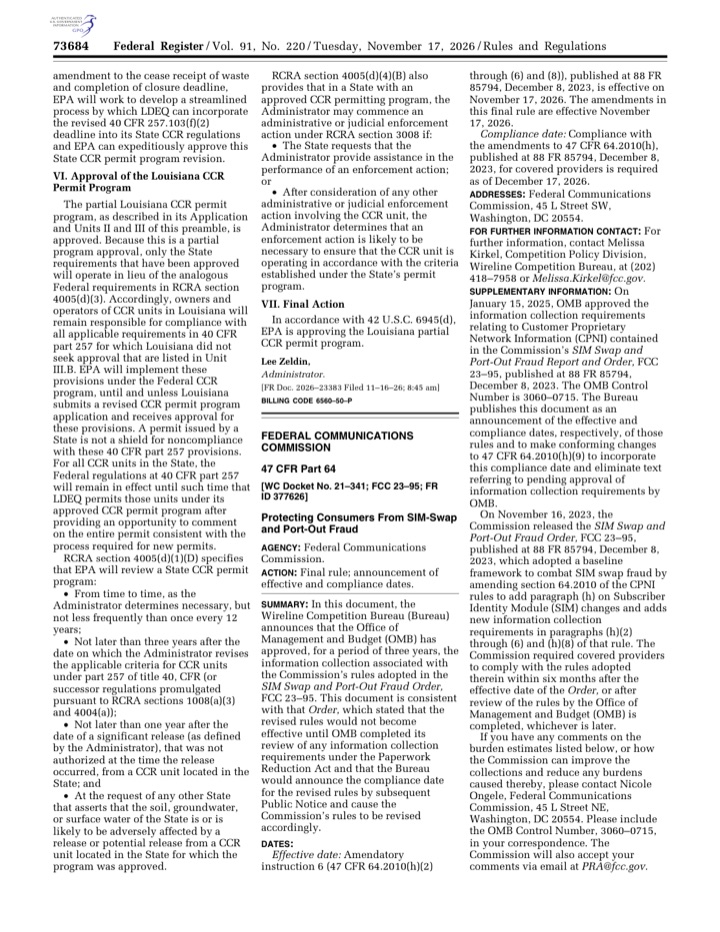
On November 17 and 18, 2026, the FCC’s Wireline Competition Bureau published two notices in the Federal Register that put the Commission’s rules against SIM-swap and port-out fraud into force. The rules were adopted in November 2023 in the SIM Swap and Port-Out Fraud Order (FCC 23-95, WC Docket No. 21-341), but compliance depended on review of their record-keeping and disclosure requirements by the Office of Management and Budget. OMB approved them on January 15, 2025. The notices now set the dates:
- SIM changes (47 CFR 64.2010(h), part of the customer proprietary network information rules): effective November 17, 2026. Covered providers must comply by December 17, 2026.
- Port-outs (47 CFR 52.37, part of the number portability rules): effective November 18, 2026. Commercial mobile radio service providers must comply by December 18, 2026.
The FCC describes the two frauds plainly. In a SIM swap, an account is fraudulently moved to a device with a different SIM, letting a bad actor control the victim’s mobile account. In port-out fraud, a bad actor impersonates the customer and has the number moved to another provider and a device the bad actor controls, so that the victim’s calls and text messages go to the criminal.
What wireless providers must do
The rules set a uniform baseline and leave providers flexibility in how they authenticate customers. According to the Federal Register notices, wireless providers must:
- Respond to failed authentication. Adopt processes for responding to failed authentication attempts on a SIM change request.
- Notify before acting. Immediately notify the customer of any SIM change request or port-out request on the account, before the change or port is carried out.
- Offer a free lock. Offer every customer, at no cost, the option to lock or freeze the account.
- Explain protections in advance. Give customers advance notice of the account protection measures offered.
- Handle fraud reports. Maintain a clear process for customers to report SIM and port-out fraud, promptly investigate and remediate SIM fraud, and promptly provide customers with documentation of fraud involving their accounts.
- Keep records. Track and keep, for three years, a record of SIM change requests and the authentication measures used.
For port-outs, providers must comply except where the Safe Connections Act requires alternate procedures.
Why it matters beyond the carrier
A SIM swap or a fraudulent port gives a criminal the victim’s phone number, and with it every text-message code and verification call sent to that number. That is why these attacks so often end in a drained bank account or a taken-over corporate login. The new notifications and free account locks make the number harder to steal, but they protect the account at the carrier. They do not change how much a company trusts a code sent to a phone.
The same weakness runs through other attacks we track, from callers who pose as the IT helpdesk to collect login and MFA codes to scammers who call from spoofed copies of trusted numbers. Security teams should treat phone-delivered codes as a backstop and move high-value accounts to phishing-resistant methods.
What is still a proposal
The 2023 order came with a Further Notice of Proposed Rulemaking, published separately in the Federal Register on December 14, 2023 (88 FR 86614). The measures proposed there are not part of the rules taking effect now. Nothing in the November 2026 notices adopts them.
Actions for the next 30 days
| # | Action | Owner | Timing |
|---|---|---|---|
| 1 | Confirm that every SIM change and port-out path, including retail stores, call centers, and online self-service, notifies the customer before the change is completed. | Head of customer care | Before Dec 17 |
| 2 | Make a free account lock or freeze available to all customers and describe it in customer-facing materials. | Product and legal | Before Dec 17 |
| 3 | Set up the three-year record of SIM change requests and authentication measures, and the process for failed authentication attempts. | Compliance and IT | Before Dec 17 |
| 4 | Document how customers report SIM and port-out fraud and how they receive documentation of it. | Fraud operations | Before Dec 18 |
| 5 | For enterprises: identify accounts that still rely on text-message or voice codes and plan their move to phishing-resistant authentication. | CISO | This quarter |
The VoiceAlerts Compliance Team can walk your team through the requirements and the records behind them in a free 30-minute briefing.
Key dates
| Date | Milestone |
|---|---|
| Nov 16, 2023 | FCC releases the SIM Swap and Port-Out Fraud Order (FCC 23-95). |
| Dec 8, 2023 | The rules are published in the Federal Register (88 FR 85794). The proposals follow on Dec 14 (88 FR 86614). |
| Jan 15, 2025 | OMB approves the information-collection requirements. |
| Nov 17, 2026 | SIM-change rules (47 CFR 64.2010(h)) take effect. |
| Nov 18, 2026 | Port-out rules (47 CFR 52.37) take effect. |
| Dec 17, 2026 | Compliance required for the SIM-change rules. |
| Dec 18, 2026 | Compliance required for the port-out rules. |
How VoiceAlerts helps
VoiceAlerts verifies who originates your traffic and who hands it to you (KYC and KYUP), keeps STIR/SHAKEN tokens healthy, and maintains the evidence regulators ask for, so your compliance record holds up as your network changes.
- Customer notification and account-lock requirements, rule by rule
- The authentication records you must keep for three years
- How fraud involving your numbers shows up across the voice network
Common questions
When do the FCC’s SIM-swap and port-out fraud rules apply?
The SIM-change rules in 47 CFR 64.2010(h) took effect on November 17, 2026, and covered providers must comply by December 17, 2026. The port-out rules in 47 CFR 52.37 took effect on November 18, 2026, and commercial mobile radio service providers must comply by December 18, 2026.
What must wireless providers do about SIM change requests?
According to the FCC’s Federal Register notice, wireless providers must adopt processes for responding to failed authentication attempts, immediately notify customers of a SIM change request before it is completed, offer all customers a free option to lock or freeze their account, give advance notice of the account protections offered, maintain a clear process to report, investigate, and document SIM fraud, and keep a record of SIM change requests and authentication measures for three years.
What changes for port-outs?
Wireless providers must immediately notify customers of a port-out request before carrying it out, give advance notice of account protections, offer a free account lock or freeze, and maintain a clear process for customers to report fraudulent ports and receive documentation of them. They must comply except where the Safe Connections Act requires alternate procedures.
Why did the rules take three years to apply?
The FCC adopted them in its SIM Swap and Port-Out Fraud Order (FCC 23-95), released November 16, 2023, and made compliance depend on review of the new information-collection requirements by the Office of Management and Budget. OMB approved them on January 15, 2025, and the Wireline Competition Bureau announced the effective and compliance dates in the Federal Register on November 17 and 18, 2026.
Sources
- federalregister.govFederal Register: Protecting Consumers From SIM-Swap and Port-Out Fraud, final rule; announcement of effective and compliance dates (91 FR 73684, 47 CFR 64.2010(h))November 17, 2026
- federalregister.govFederal Register: Protecting Consumers From SIM-Swap and Port-Out Fraud, final rule; announcement of compliance date (91 FR 74126, 47 CFR 52.37)November 18, 2026
- docs.fcc.govFCC: SIM Swap and Port-Out Fraud Report and Order (FCC 23-95), WC Docket No. 21-341Released November 16, 2023
- federalregister.govFederal Register: Protecting Consumers from SIM-Swap and Port-Out Fraud, final rule (88 FR 85794)December 8, 2023
- federalregister.govFederal Register: Protecting Consumers From SIM-Swap and Port-Out Fraud, proposed rule (88 FR 86614)December 14, 2023 (proposals, not rules)
This article is for general information and is not legal advice. Proposed rules can change before adoption; check the FCC record for the final text.